
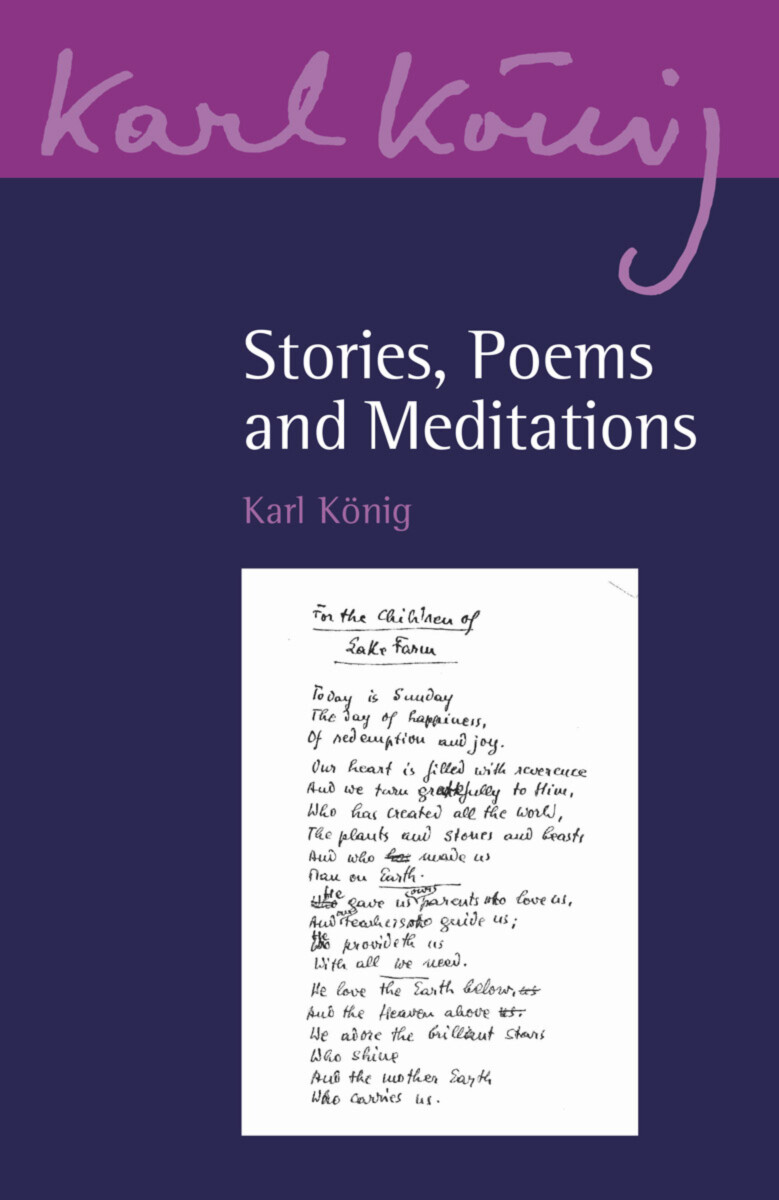
Stories, Poems, and Meditations Alongside his work with the Camphill movement, Karl König was a prolific writer of stories, poems and meditative verses. This book contains: A selection of his creative work Verses for specific occasions Twenty-four poems Four stories for children Ten other short stories An extensive introductory essay explores the cultural environments in which König was writing—including Vienna in the early twentieth century, and the challenging times leading up to World War II—and discusses the creative development of his literary work. C O N T E N T S: I Want the Meaning of Life The Lyrical Work of Karl König (Introduction by Alfons Limbrunner) Editor’s Note (Richard Steel) Meditative Verses Christmas 1944 Guardians of the Services For the Goetheanum Windows For the Children of Lake Farm For the Friends in America Poems For Alfred Bergel Untitled [1920] Untitled [1921] Whitsun To You, Brother Proletarian! For Albert Steffen’s Pilgrimage to the Tree of Life Calling Up Untitled [for Tilla 1938] For You For Me For Turner, the Great Painter To Germany Untitled [ca. 1940] For the Camphill Community Prater Pound and Dollar Verse for the Human Being Easter Morning St John’’s Day Whit Sunday Eye and Ear Calendar Verse [1961] Calendar Verse [1962] The Tourmaline Secret One Last Poem? (Richard Steel) Karl Konig’s Last Poem Stories for Children Two Addresses for Children Michaelmas Advent Two Parables Arranged for Eurythmy The Treasure in the Field The Pearl in the Shell Short Stories The Bohemian-Moravian Brotherhood The Monk’s Dream The Idle Tongue Brother and Sister Athena Parthenos The Three Days Christmas Past, Present and Future A Highland Story One Morning 1352 bc Also a Christmas Story Karl Konig’’s Christmas Story (a postscript by Richard Steel) Appendix Notes Bibliography Index About the Author Karl König (1902–1966) was born in Vienna, in Austria-Hungary, the only son of a Jewish shoemaker. He studied medicine at the University of Vienna and graduated in 1927, with a special interest in embryology. After graduating, he was invited by Ita Wegman to work in her Klinisch-Therapeutisches Institut, a clinic in Arlesheim, Switzerland for people with special needs. He married Mathilde Maasberg in 1929. Dr. König was appointed paediatrician at the Rudolf Steiner-inspired Schloß Pilgrimshain institute in Strzegom, where he worked until 1936, when he returned to Vienna and established a successful medical practice. Owing to Hitler’s invasion of Austria, he was forced to flee Vienna to Aberdeen, Scotland, in 1938. Dr. König was interned briefly at the beginning of World War II, but on his release in 1940 he set up the first Camphill Community for Children in Need of Special Care at Camphill on the outskirts of Aberdeen. From the mid-1950s, König began more communities, including one in North Yorkshire, the first to care for those beyond school age with special needs. In 1964, König moved to Brachenreuthe near Überlingen on Lake Constance, Germany, where he set up another community, where he died in 1966.
Related products
-
$ 0.82 Select options This product has multiple variants. The options may be chosen on the product page
-
$ 3.06 Select options This product has multiple variants. The options may be chosen on the product page
-